
1
Launch reaction threads
Show how creators, customers, or critics might react to a product update or announcement post.
Stage X reply chains with nested comments, verified profiles, usernames, likes, and reply counts. Export screenshots or videos.
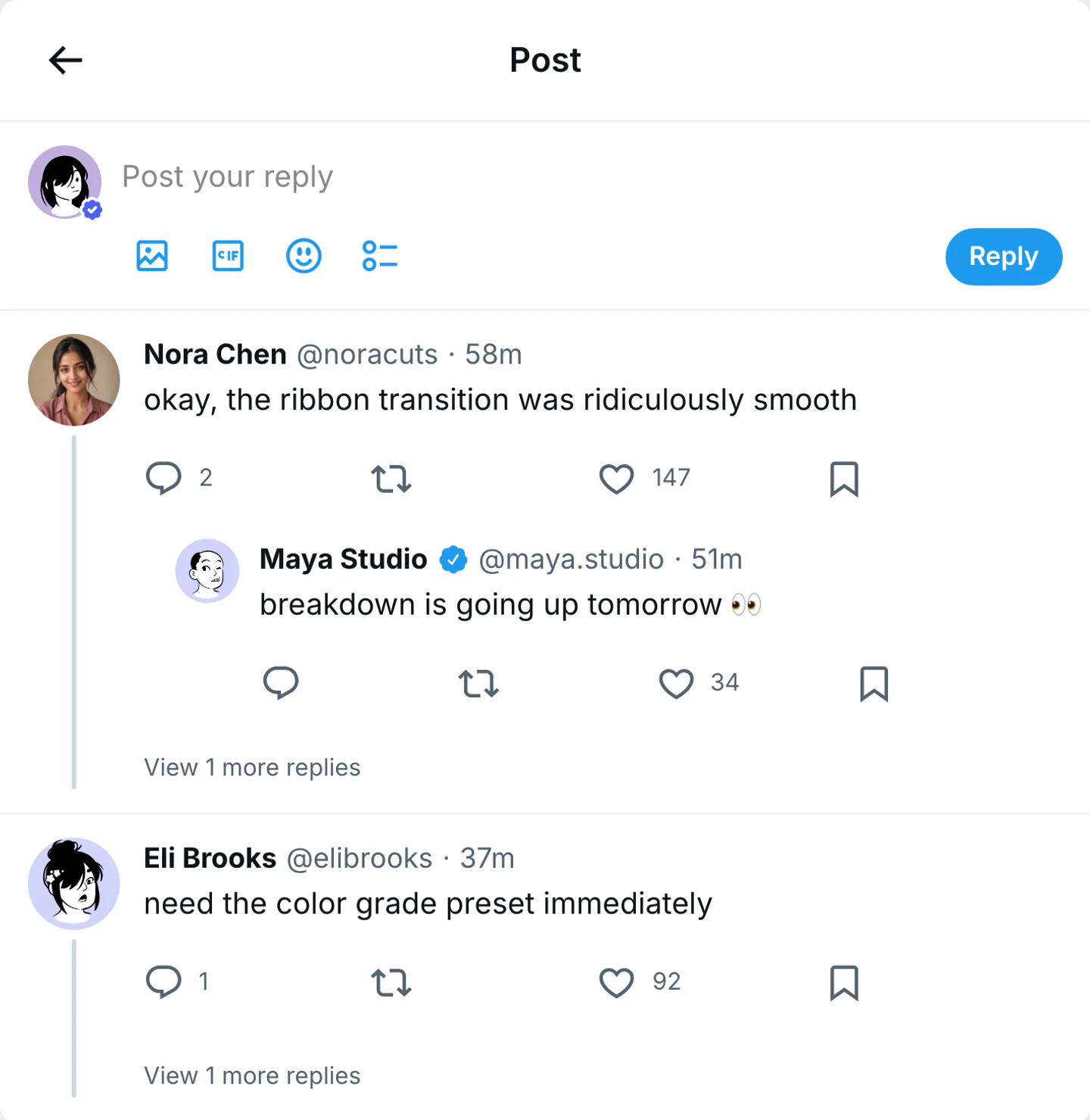
Real X replies export
Three reply screenshots: a two-level dark chain, a light-mode follow-up, and a three-voice thread. Keep the depth shallow unless the scene is actually an argument.

The first reply lands the reaction. The nested reply answers it. Profile scale and like counts stay in the same imagined audience.
Use this example
Same nesting, lighter chrome. Use this when the timeline insert needs to read as a daytime scroll.
Use this example
Three top-level replies, no deep nest. Useful when the scene is a room reacting, not a two-person argument.
Use this examplePick the right format
Use X (Twitter) comments when the audience reaction matters. Replies, pinned notes, likes, and nested context show how people respond to the post.
Show how creators, customers, or critics might react to a product update or announcement post.
Build stacked reply chains for commentary content, opinion posts, and satire-led social edits.
Use quote-like reactions and sharp short replies to create native-feeling humor around one main post.
Workflow
Step 1
Select X (Twitter) from 45+ supported apps and choose comments mode.
Step 2
Edit commenter names, replies, likes, timestamps, thread depth, pinned states, and appearance options.
Step 3
Download a comments screenshot or short reveal clip when the thread reaction is the hook.
Features
Set the interface cues that make an X (Twitter) comment thread recognizable, then export it for close-up edits.
Open the X (Twitter) comments editor with the top comment, replies, timestamps, and reaction areas already in place.
Shape top comments, replies, pinned labels, creator cues, timestamps, and nested discussion flow.
Set display names, handles, avatars, verification, and tone so every reply fits the scene.
These are the details viewers notice first when an X (Twitter) screen appears on camera.
Also included
X reply chains feel believable when the post, the replies, and the engagement ratios all belong to the same imagined audience size. A strong main post can still feel fake if every reply is too polished or every metric looks inflated.
Common mistakes
Most weak mockups fail on context, not polish. Fix these before you export.
Comment threads work best when reactions feel quick, specific, and slightly messy.
Too many reply levels slow the scan. Keep the strongest reaction visible first.
Use X (Twitter) labels, likes, pinned cues, and timestamps only when they clarify the thread.
FAQ
Quick answers about workflow, realism, and export decisions.
Compare comment thread generators when the replies or audience reaction carry the scene.
Same platform
Create X post mockups, reply chain screenshots, profile-style previews, verified badges, and engagement metrics for social concepts, decks, and editorial visuals.
Open generatorRelated generator
Create fake TikTok comments with custom usernames, likes, creator badges, timestamps, and reply chains.
Open generatorRelated generator
Create fake YouTube comments and comment threads with channel names, @handles, likes, replies, pinned comments, and creator hearts for screenshots, shorts, and video concepts.
Open generatorRelated generator
Create fake Instagram comments, comment sections, threaded replies, pinned comments, and timestamps.
Open generatorOpen the comments editor, edit the replies, and export the finished thread.